Showing posts with label vintage. Show all posts

Tuesday, August 11, 2020

Thank you for 8 years of fun exploring all things Hendryx.

 Dear "Hendryx Hoarder" followers,

I opened this blog in 2012 and spent 4 very active years labeling, dating, identifying and drooling over Hendryx cages.  Thank you for participating and giving me questions and cages to research (which I dearly love).

I have been monitoring the email address associated with this blog for the past 8 years.

I've decided it's time to close down this blog.  The information that is on it will remain, but I will no longer make any new posts or monitor the email address.  Please feel free to read this blog and hopefully it will answer some questions for you.

Thank you, again, for your patronage these past 8 years.

Keep shopping.  Keep looking.  Iconic Hendryx cages are still "out there".

Barbara

Sunday, January 3, 2016

Hendryx cage dating

Happy New Year 2016!!


I received a note from Cindy asking if I could date the cage she found at a flea market in CT.  She sent the following pictures.


This cage has the round finial on top, Hendryx tag on the door, seed screen guard, opposing-hearts feeder guards, riveted technology as seen on the front door, and decorator scalloped strips over the two horizontal rails.  The base is flat without a pull-out tray and is held to the top of the cage by 4 swivel latch hooks.  It looks like it has the cross-cage perch and one of the feeder perches as well as the original swing.

Using my Hendryx trade catalogs for reference, I found this cage in the 1926 and 1930 catalogs.  It is not in the 1932 catalog.  The base that is in the picture in the catalogs has a moulded base and a pull-out tray.  This flat-tray base came earlier and usually had a tin tray insert on top of the base that could be pulled out easily once the clips were loosened.

My next earlier reference catalog is 1910.  The cage is not in that catalog.  The finials are different in those early cages.  

Because of the tray, I would date this cage from the late 19-teens to the early 1920s.  There are cages in the 1926 catalog that offer either the flat tray like this cage has, or the moulded base with pull-out tray.  These cages didn't offer that option so this cage came before the 1926 catalog.  This is what makes me think that this 10 yr. or so period is correct for this cage. 

The feeders for this cage are the open box opal glass winged feeders.  The heart doors lift up and the feeders slide into the openings.  See below examples.


Congratulations, Cindy, on a GREAT find.

If you have cages you are curious about, please write to me at tweetthings53@gmail.com.  I will research my catalogs and see what information I can share with you.

You can still cage hunt even though it's winter, as evidenced by Cindy's wonderful cage.  Spring is not too far away.  Then you can stretch your legs in the spring air and start going to the open air markets and garage sales.  (That is if the snow is gone by then).  

Great Hendryx cages are still out there.  Keep looking and happy hunting.

Barbara

Saturday, September 19, 2015

"Hendryx Enhanced" #2-Guest Contributor Miguel in Mexico


This is the second visit to my blog for Miguel.  He first contributed in May 2015 and he's done another marvelous job on this first cage.  This is how I introduced him in May:

 Miguel contacted me through this blog and said he collected Hendryx cages too.  He gets them from markets or on the internet.  He repairs them, if needed, then intervenes artistically so they will be more pleasing to the senses.  He has a creative spirit and does all his work freehand.  These belong to a collection that is "an artistic intervention to an ancient object without losing its original function".

Let's get some pictures in here so you can see what I am talking about.

This cage is found in my Hendryx catalogs from the late 1920s to the early-to-mid 1930s.  The seed screen guard has been removed for easy viewing of the floor which is decorated with a crane and a cherry tree.

Note the polished base as well as the enhanced upright to the stand.              The upright pole is wrapped with actual tree bark.


The perches and swing are hand painted and covered with a polyester layer so the paint is protected and is not harmful to the birds.

Look at this amazing art work!!


This bird is a model and does not live in the cage.

Here are several more pictures of another cage of his.


For more photos from Miguel, look at my May 2015 blog post.

Thank you for joining me as we celebrate Miguel's artistic abilities added to the always-great Hendryx cages.  It's always a pleasure hearing from him.

If you have any pictures of Hendryx cages you found over the summer or have any questions, please write to me at tweetthings53@gmail.com.  I will add the pictures as a guest contributor.

Fall is around the corner but the weather should still be good enough for more shopping for and buying of those amazing cages by The Andrew B. Hendryx Co.

Have a blessed day.  Happy Hunting.

Barbara

Friday, July 3, 2015

"Hendryx" in the 1930s

Welcome to the 30s!!  The Andrew B. Hendryx Co. was busy as usual turning out one great cage after another.  They'd been in business with the Hendryx name since 1869 and their reputation was solid.  As in previous years , the inventors were busy and patents were pending. 


Check out this cage from the 1930 Hendryx trade catalog #42.  
I think it is stunningly attractive.  
It also came in a meadow green finish.


Even the unbreakable Pyralin feeders were patent pending.


Also in the 1930 catalog is this uniquely shaped cage.  
This cage would have come with the Pyralin feeders also.  I don't have any so I dress it out with the opal (milk) glass oval feeders.
It also came in a tangerine and ivory finish.


Again, from Catalog # 42 comes this mushroom-shaped cage called 
"The Bower".
It, too, would have had Pyralin feeders.
This cage also came in a green 2-tone finish.


Lou Ann generously offered these guest photos of another patent pending cage.  This time it's from Catalog #43 in 1932.  
It's called "The Nippon"
"A modern development of a popular oriental design"


Here are pictures of some of the patented cages that were also offered in the 1930 catalog:


85 years ago, these cages were offered for sale in the 1930 & 1932 Andrew B. Hendryx Co. trade catalogs.  They are still quite popular with collectors.

I hope you've enjoyed this trip down memory lane.  I continue to be amazed at the quality and variety offered by the Hendryx Co.

I hope you are enjoying your summer.  If you've found some Hendryx treasures, please write to me at tweetthings53@gmail.com and include some pictures.  I will post them as guest photos.

The time is ripe for garage and estate sales, and discovering the treasures in attics and collectors' markets.  Happy Hunting.

Barbara


Saturday, June 6, 2015

Hendryx seed guard scavenger hunt

There is a reader who contacted me with an item request.  I am passing it on to you.  For all the Hendryx collectors "out there", please look over your surplus parts and pieces.  Keep your eyes open.  I would like you to join a scavenger hunt.


The photo above is taken from the 1949 Hendryx trade catalog.  It shows two chromium cages.  The scalloped cage on the left has glass seed guards with the "fired on" black and white design.  The one on the right has a plain, rounded top and has bound plastic seed guards.

The reader is looking for these seed guards.  They are a thick vinyl-like plastic that are material-bound on the edges, that go on the front, back, and both sides of the cage. 

If you have some that are available for purchase, please write to me at my email address tweetthings53@gmail.com.  Or leave a comment here.  I appreciate your help as this reader continues the quest to complete a Hendryx cage.

Thank you.
Barbara

Sunday, May 31, 2015

Hendryx Enhanced

Today I would like to show you some photos from a collector in Mexico. Miguel contacted me through this blog and said he collected Hendryx cages too.  He gets them from markets or on the internet.  He repairs them, if needed, then intervenes artistically so they will be more pleasing to the senses.  He has a creative spirit and does all his work freehand.  These belong to a collection that is an artistic intervention to an ancient object without losing its original function.

Let's get some pictures in here so you can see what I'm talking about.

First to know is that the birds are models for the photos.  They do not live in these cages.


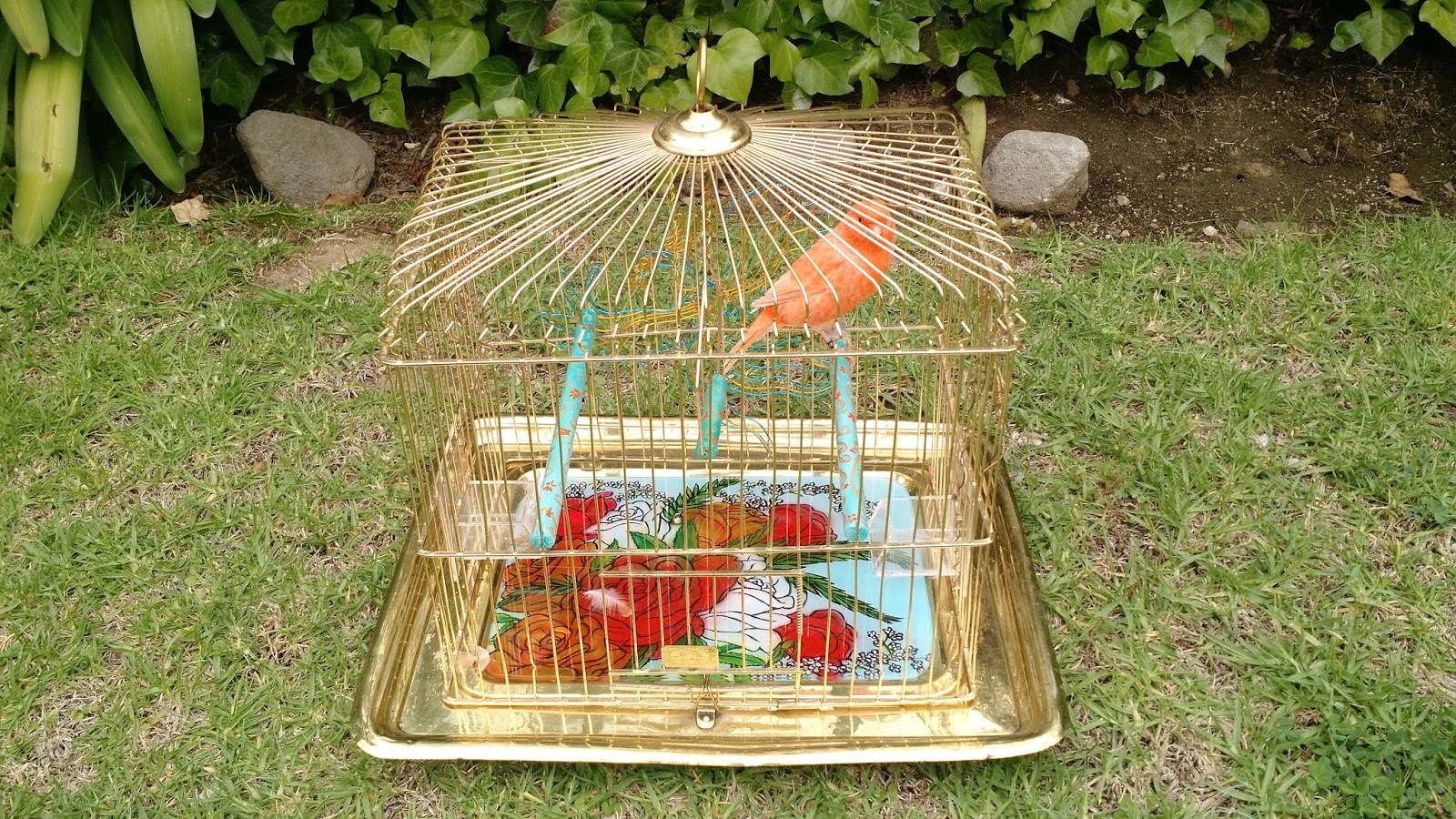
Several things to notice on this first cage.  Note the blue hummingbird wire sculptures on the back wall.  Note the wires that support the swing.  The blue feeders compliment the blue floor and perches and tie the color scheme together.  (Blue is my favorite color and I find this very appealing.)  This is a 1930s cage that is anything but plain.


Look at the back wall of this fine Hendryx cage.  There is  a large bird intricately woven in the cage wires.  The perches and swing are hand painted and covered with a polyester layer so the paint is protected and is not harmful to the birds.


Here is a lovely floral arrangement on the base of the cage.  The bird model is well chosen as it blends with some of the flowers.

The purple in this Art Deco cage adds a little spice to a simple cage design.


Check out this classic beehive by Hendryx.  It looks anything but classic.  More like "classy".  The swing and perches are decorated to match the orange color scheme.  The bird looks to be the best model for this cage!  


Look at the floor to this beehive cage.  What a work of art!!  It is an amazing butterfly painted by hand which covers the whole floor.  The screen seed guard has been removed so nothing blocks the view to this masterpiece.


I have seen cages painted, cages with plants hanging in them, and cages in the back yard without doors so the wild birds have free access to them; but this is the first I've seen or heard about the artistic enhancement of an older object without losing its original purpose.  I think it's great.

I'd like to hear your comments on this.  There is a place at the bottom of this entry where you can comment.  If you have done some creative enhancements to your Hendryx cages and would like to share with us, please write to me at my email address tweetthings53@gmail.com and send some photos.  I will post them as a guest contributor.

Thank you for your time.  And again, "happy hunting".
Barbara